How To Actually Learn A Language - 2028 Edition
I wrote “How To Actually Learn A Language” almost a year ago and while I still stand by all of the advice I provided, I had not actually learned a new language in maybe 8 years. The landscape for learning a language has obviously drastically changed in that time. Resources have gotten a lot more abundant and I wanted to provide an update for how I would approach learning a language nowadays. Furthermore, my previous post was a bit more theoretical and psychologically focused rather than practical. This article will provide a more practical approach to learning a language quickly and efficiently.
In order to provide this update, I obviously needed to begin learning a new language. Now as nice as you may think I am for doing this, I did not really learn a new language for this blog post. We are going to Seoul for a week in January and I hate going to a country and forcing people to speak my native language, so I began learning Korean. It seemed like the next logical step in my language learning journey as I already know Japanese and Chinese. My approach to learning languages is now refreshed, refined and ready to be shared here. I have been studying for about 2.5 months and I know about 1000 words, all A1 and A2 grammar, can read simple stories, and most importantly, have simple conversations like “What did you do this weekend”, “What food do you like to eat”, “How do I go to XYZ place”, etc. I am very much still a beginner but I have made rapid progress with this approach and I think you will too.
Step 1: Solidify Your Language Learning Goal
Why do you want to learn this language? Do you like consuming media in the target language? Are you planning to visit the country and want to speak to locals? Do you find the girls from that country cute? Or is the goal more academic? You need to know why you want to learn the language so you can focus on learning the most important things to help you achieve your goal. If you like watching anime, well you probably should focus on listening practice. If you like reading academic articles you need to practice reading more. The method I provide will give you a holistic approach to learning the language, and you need to tailor where you want to spend the most time. That does not mean you will skip reading practice in favor of listening, you will just do more listening practice than reading practice.
The next important question is how fast do you want to learn this language. I have 3 months before I go to Korea. This means that I had 4.5 months to study Korean to get good enough to have conversations and be an all around cool guy before I go. I can already speak enough to get by (I think) and it has taken me 1.5 months, The next 3 months I am focusing on getting to the “next level”. The next level for me is being able to understand 50% of what is going on in a K-drama, talk a little bit deeper in Korean with more command over intermediate vocabulary, and begin reading short stories that are not in graded readers. So what do you want to achieve in your allotted time?
ACTION ITEM Take some time and write down a few reasons why you want to learn the language, how much time you have to learn the language, and what you want to be able to do with the target language by the time the allotted time has elapsed.
Step 1.A: Necesary Materials
- 2-3 notebooks
- Master Vocab Notebook
- Scrap Notebook to test vocab
- Essay Notebook
- Planner
- This can be self made in another tiny notebook, but you want something nice that is going to make you want to go in and check off the boxes of the tasks you completed
- A good pen
- A way to interact with an LLM (free is fine, preferred. who wants to pay for that crap)
- A language proficiency test vocab list (online, free, covered below)
- A list of all grammar points from A1-B2 (online, free, covered below)
- Access to a graded reader (online, free, covered below)
ACTION ITEM Go to the store and get some nice notebooks, most of language learning is free so enjoy buying some fancy paper.
Step 2: Plan Your Ideal Study Week
Making a weekly plan is going to help you stay on track and reach your goals in the time you have. Before you determine what a weekly plan will consist of, you need to think about how much time you can realistically spend on learning the language each day. I am currently spending 2-3 hours on language learning daily. The majority of the days I hit my goals, some days I do a lot less. That is okay, you do not need to be perfect, you just need to know how much time you realistically want to spend and then try to reach that goal as best as you can. I will give an example of what my weekly plan is, and the subsequent sections will go into what you will actually study and how you will study.
My Current Weekly Study Plan
- 6 new grammar points
- 100 new vocab words
- Previous week’s vocab review
- 7 hours of listening
- 4 reading sessions ~20 min each
- Keep up with Anki flash cards
- Weekly Tutoring & Homework
- 2 Short Essays
- 2 Short IRL conversations
This seems like a lot. It is. I never hit a perfect week. I do not expect to hit a perfect week. The perfect week is something to strive for in efforts towards your goal. If you do hit a perfect week, you probably are under-allocating study material or over-allocating time. I am also constantly changing my weekly study plan to fit my current needs. I am writing this article slowly and my plan has changed multiple times since I started writing. Just make sure your plan is getting more intense, instead of easier, unless you over allocated originally.
I keep track of my weekly goals in a planner. I draw boxes for each section and fill in the boxes when I complete a daily task. This keeps it fun and allows me to track my progress. I recommend you do the same. Picture below for reference.
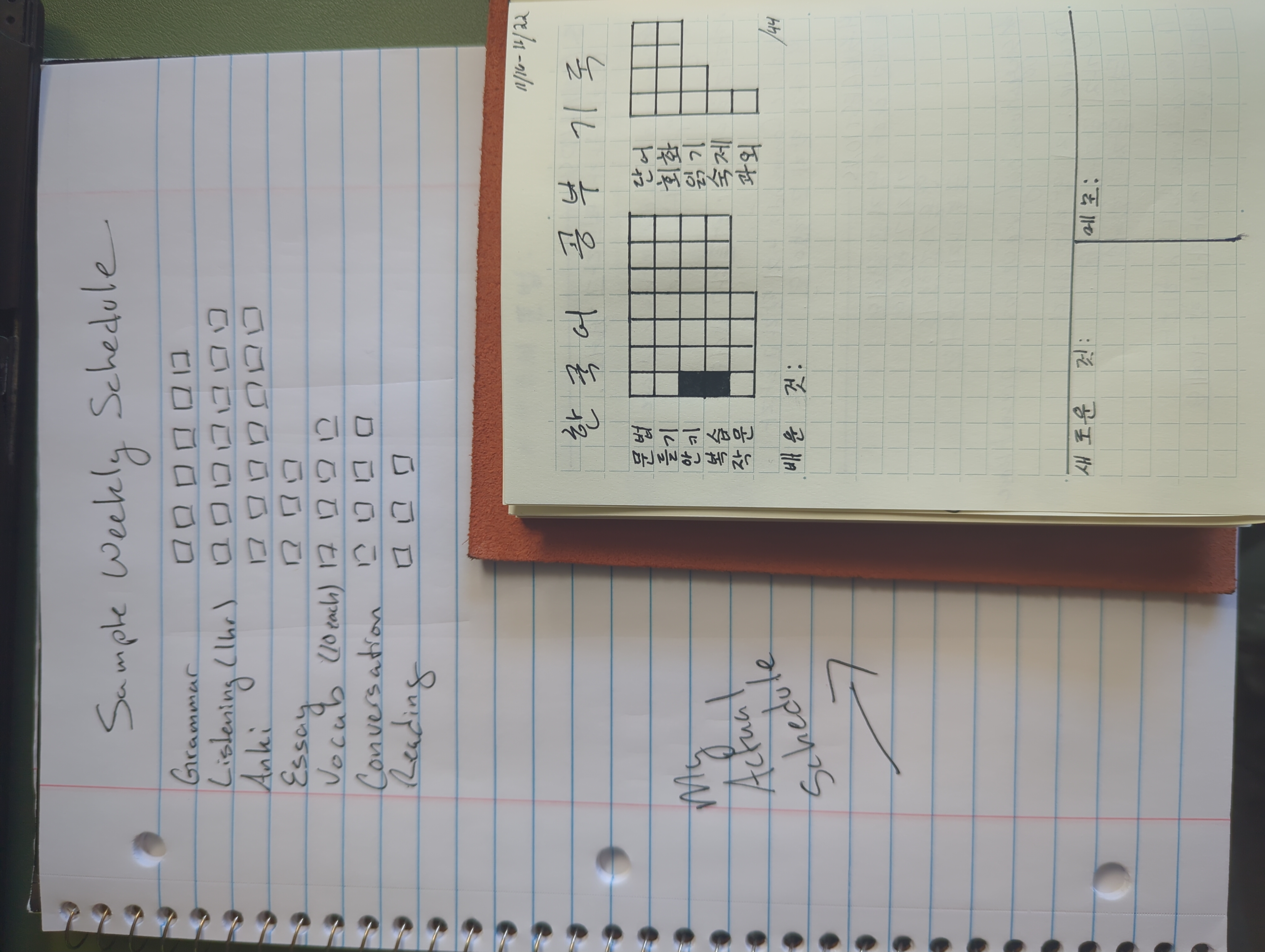
What if you only had 30 minutes a day and your main goal was conversation in the target language? Here is an example plan:
Busy Person Study Plan
- 2 new grammar points (1 in a day, 2x a week)
- 40 new vocab words (10 in a day, 4x a week)
- 10 min of listening daily
- 10 new anki flash cards daily
- 2 short IRL conversations
- Tutoring session once a week
If you really only have 30 minutes max, you will never hit the perfect week here. That is fine. But you need to be realistic and understand that your progress is going to be a lot slower than someone with 1-3 hours per day dedicated to the language. That is fine, go at your own pace.
ACTION ITEM Get a notebook and start creating your own weekly tracker.
Step 3: The Alphabet
The absolute first step for learning a language is learning the alphabet. If you do not know the alphabet of the target language you cannot learn the language. Do not even think about learning it in a romanized form, you are wasting your time.
If your language has a phonetic alphabet (you have it easy) you need to quickly learn the alphabet. Watch a youtube video that explains the alphabet and how each letter/character is pronounced. Get a piece of paper, write down each letter in the target language on the left side and the english on the right side. cover the left side and test yourself by writing the letter/character on another piece of paper. Find random sentences online and just write those sentences out. Do not worry about the meaning, just get comfortable writing the alphabet. This should be very easy to learn and should not take more than 1 week. Consider this your pre-study phase.
If your language is Japanese you have three alphabets to learn: Hiragana, Katakana and Kanji. Write each hiragana and katakana 100 times, learn the proper stroke order for them. Then on a piece of paper write their english equivalent down one side of the piece of paper and their japanese equivalent on the other side, cover the Japanese side and test yourself by writing out the hiragana/katakana on a separate piece of paper. Do this until you are comfortable with both hiragana and katakana. This should only take a few days if you are dilligent.
When it comes to learning Kanji and Hanzi (for Chinese), this is a life long study process. When it comes to Japanese, you can get by with just hiragana and katakana for the first few weeks (a class will tell you the first year, I disagree). You need to learn how to write kanji with the proper stroke order. When you learn kanji you should learn them in tandem with the vocabulary words you are learning. Learning them in isolation is less efficient.
Chinese has no phonetic alphabet so you need to start learning hanzi right away. I would say start with 20 a week, but start bumping that number up. Again, you are learning the characters with vocabulary words (which we will talk more about below), so the amount of vocab you learn per week will dictate the amount of hanzi you learn per week. You will need at least 1500 hanzi by the end of your language learning journey. Start now do not wait. Study method is in the vocabulary section below.
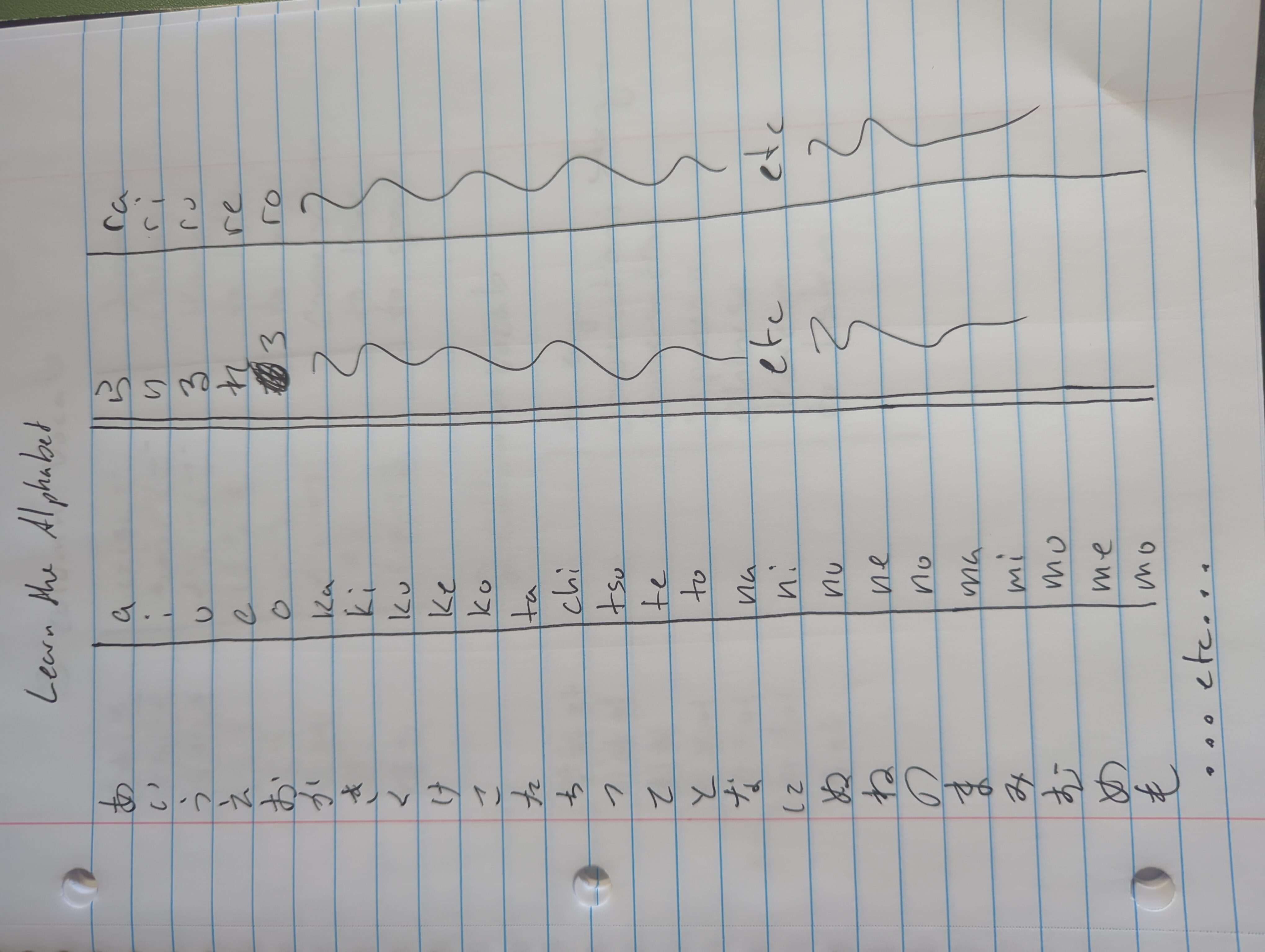
Side Note: I learn alphabets for fun even if I am not learning the language. It is an easy and fun activity that generally only takes 1 week to do. I can read/write around 15 alphabets but I only know ~5 languages. You will be surprised how much information you can grasp from a writing system in a language you do not know. You see a Russian store in town, all of a sudden you can read it is a Deli or a pharmacy because the the words are similar to English.
Step 4: Listening
You need to listen to the language you are learning as much as possible; especially if your goal is to become conversational. Self studying a language is mainly an individual exercise and you need to expose yourself to the language constantly for it to actually begin clicking in your brain. Comprehensible input is a form of listening in which the target language is spoken slowly and clearly. You may watch a video that just talks about colors for an hour. The speaker will be looking at a picture of playing a video game and have a dialog with you. “What color is this? (Pause) This is red.” This pattern gets drilled into your mind over the hour and all of a sudden you just intuitively know the colors and how to ask about them. This is crucial for the beginning phase of learning the language.
You should spend at least a month listening to comprehensible input for at least one hour a day before moving on to anything more difficult. You will be amazed at how much you learn just by osmosis. Just go on youtube and search “Comprehensible Input Japanese” and you will find a plethora of channels providing comprehensible input videos at all levels. This format technically could carry you all the way up to the intermediate level if you devote 100s of hours solely to comprehensible input. We are not going to do that though, as a well-rounded approach is, in my opinion, going to speed up your language acquisition.
When I was learning Japanese over 15 years ago the youtube language learning landscape was quite different. There were a few decent language teachers on there that were not really incentivized to post daily or weekly like they are today. There was also not the inundation of “how to learn a language” videos as there is today either. I literally just learned about comprehensible input a month ago. So what did I do back then? Watch anime and J-Dramas.
If you want to watch native content in your target language, you can, but you have to accept that you are going to progress slower with this method. The language will be way too difficult at first and you may only pick up 10% of the words depending on how far along you are. I still think native content is important though. You need to be able to interact with the language at full speed and the only way to do that is to train yourself by listening to native people speak as they normally do in daily life. If you watch comprehensible input all day and you only hear slow conversation, you will not understand normal speed conversation.
If you plan on watching native content, please do not watch some weird anime and adopt weird anime words. Something like Full Metal Alchemist or Attack on Titan are not good choices. You need to be watching slice of life type material where people talk about the mundane. You are wasting your time learning how to talk about these hyper specific themes as you will most likely never use them in real life unless you are talking about that specific show. So watch a romance drama, watch a variety show, a travel show, an anime about going to school or going to work or playing a sport or something like that.
When you switch from comprehensible input to native content is up to you. You can do both simultaneously if you want as well. I have switched (for now) to watching a K-Drama at 6 weeks in. This is too early for me and I know that. But I have also had moments where I followed full conversations in the drama and those types of wins are what really helps the language click in my opinion.
Comprehensible Input - No Subtitles
Native Content - Subtitles in target language only
ACTION ITEM Find a comprehensible input youtube channel for your target language.
Step 5: Vocabulary
As we move onto vocabulary learning, we are getting closer to the production phase of language learning. Instead of just listening you will be recalling, writing, and testing yourself systematically on vocabulary words. Hopefully you have determined about how many vocabulary words you think you can learn in one week. If not, and you are new to language learning, I would recommend 40 words a week. That is 10 vocabulary words spread across 4 days. I am going to reiterate here that language learning thrives on consistent mini actions taken over time rather than intensive cram sessions. If you are learning 40 words in one day, then you actually should be learning 160 words a week.
Vocabulary lists can be obtained many different ways, but I think the easiest way will be to take a vocabulary list from the lowest level language proficiency test of your target language. Japanese has the JLPT, Chinese has the HSK and Korean has the Topik exams. Any vocab list geared towards a beginner or intermediate language proficiency test will have high frequency useful words.
Another vocab list you can grab are frequency based vocabulary lists. the frequency is often determined by analyzing written documents like books or newpaper, so they are not always the best for a new learner. But if you are mainly interested in reading, they may be perfect for you.
Okay now that you have found a list of about 1000 words (or a set of lists that add up to around 1000 words), you want to feed that list into an LLM/Chatbot and have them organize the list by theme. You do not want to go through a list alphabetically. There are 100s (probably 1000s or more) of words that start with か in Japanese and you are just going to get confused by all these words that sound the same. Themes like shopping, cooking, going on a date, etc are way more useful for you to paint a picture of the vocabulary ecosystem you are currently in. Make sure the themes are broken up into chunks that fit your daily vocabulary study amount. So if you study 10 words a day, the theme should have 10 words in it, or at least a multiple of 10. If it has words outside of the theme it is not a big deal, you just want to approximate some sort of relationship within the group of words.
With your list organized and chunked, you can finally start studying vocabulary. Get a fresh ruled notebook and depending on your language you are going to separate the page into 2 or 3 parts. If your language uses ideograms like Kanji you will want 3 sections, if you are learning a language with a phonetic alphabet you only need two sections. Draw vertical lines down the page to mark the section.
For languages with ideograms, the first section, all the way to the left of the page will have the ideogram/kanji/hanzi. the middle section will have the pronounciation, and the right hand section will have the english translation of the word. For languages with a phonetic alphabet, the left side has the word in the target language, the right side has the English equivalent.
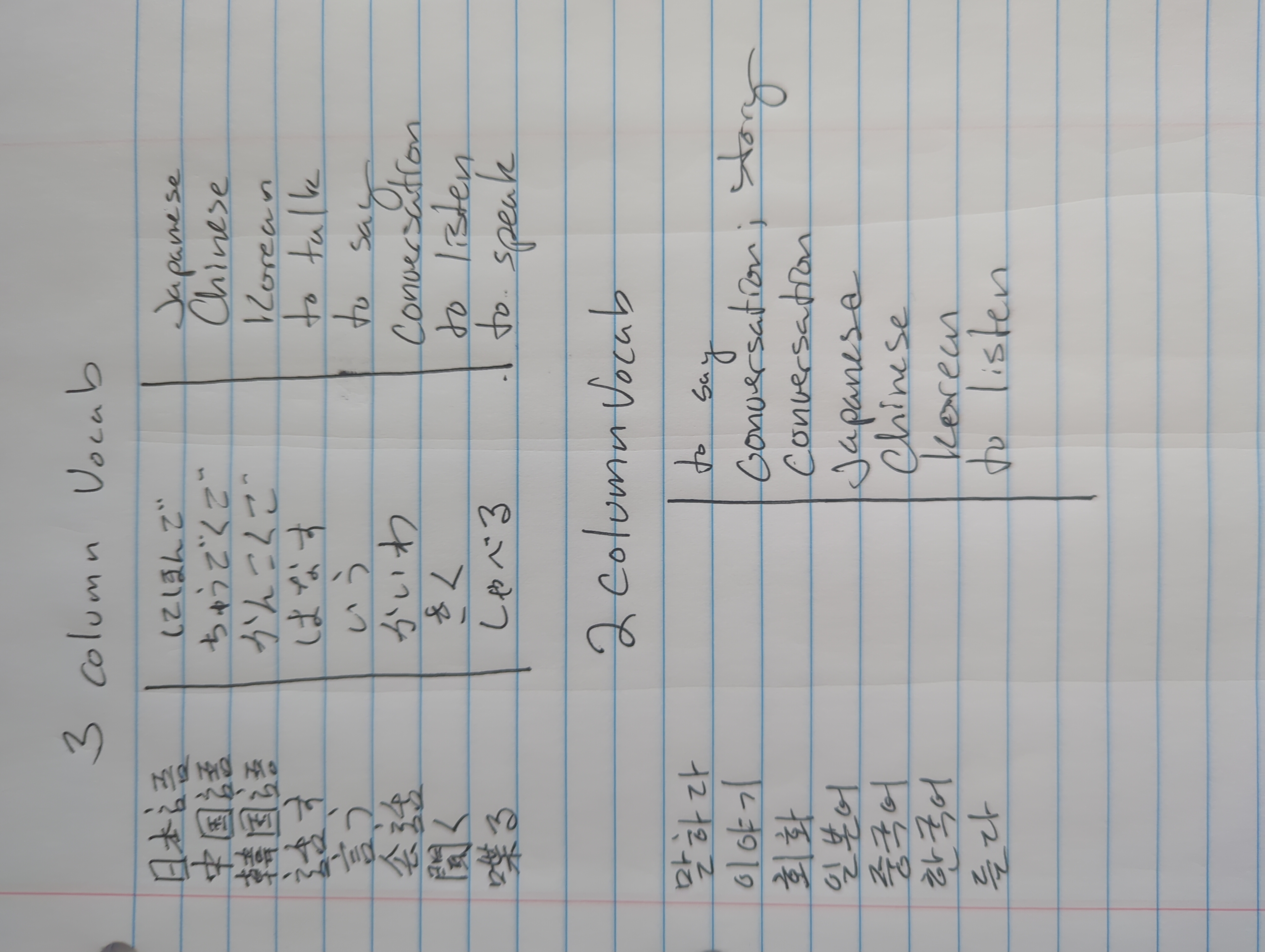
You are going to go through the list, say each word aloud in the target language and then the translation. Try to commit the word to memory. Now take a scrap piece of paper and cover everything but the English section. In a second notebook or on a scrap piece of paper, you are going to test yourself. Write the word in the target language. This is going to be difficult at first but eventually you will begin to remember the words. It may take you 10 peices of scrap paper to get through the first list, but in a few weeks you will breeze through this.
If you get any of the words wrong, make a small mark on the sectioned off page in the English section. Once you are comfortable with 50% of the words, you can spend time just drilling the ones you are struggling with. Once you are happy and think you know all the words, do one more final test of the whole page. You have completed the first phase of learning the vocabulary word.
This process does not actually mean you have learned the word, instead it has exposed you to the word and has created some sort of connection to the word in your brain. Some words will have stronger connections than others. That is fine.
Now we need to move on to the second phase of vocabulary learning: Anki. In my previous post I spoke about how making your own flashcards is better than Anki. I am revising that opinion: If you study vocabulary on paper first, then move those words to Anki, it should be just as effective. Okay what is Anki? Anki is a flashcard system that has an algorithm that is supposed to aid in memorization through spaced repetition of the target information. So you study a word one day, mark it as easy, it will show up again in a week. If you mark the word difficult it will show up tomorrow. The algorithm is way more complex than that, but that is not why you are here, go watch a youtube video if you are interested.
Take your sorted vocabulary list, give it back to the LLM and tell it to make you an Anki deck with the vocabulary word in the target language on the front, and an example sentence and english translation on the back. If you know a language that shares a relationship with your target language, add the translation to that language as well. My Korean flashcards have Japanese and English on the back. The LLM will be able to generate all of this for you, just tell it to do it like the slave it is.
Okay import the cards into Anki, create a new deck, set your daily new card amount = how many vocab words I learn in a week / 7. that way every day you get new words, but those words do not come so fast that you have not studied them on paper yet. If you feel like you are lagging behind on paper, pause the deck so it stops giving you new words until you catch up. The goal is to not lag behind. If you need to learn how Anki works, watch a 20 minute youtube video. I am not giving a technical explanation here.
Now you are learning vocabulary on paper every week, and the words you learn are popping up in your Anki deck and you are making sure that your connection to the word is getting stronger. However, there are two more connections that need to be made. 1. You need to hear the word being said, this can happen in comprehensible input like we discussed above, or in real life (which is even better); and 2. you need to use the word for real in a real life situation with a native speaker. How else are you going to know that you can use the word if you do not use it. If you never need to use the word, it was not useful anyway. But if you never need to use the word because you do not speak in your target language (and your goal is speaking) there is something going wrong. You do not need to fret about hearing/using the word just yet though. Right now making those connections on paper and in Anki are good steps towards fluency.
You only need 1000 words to have simple conversations in your target language. If you do 50 words a week you will be there in 20 weeks. 5000 words will take you to the next level and you will be cracking jokes and having deeper conversations in the language. At 50 words a week, that will take 4 years!!! but guess what, this is not the only way you will learn vocabulary. Once you have 500-1000 words and you are watching native content (which you should be doing right away with comprehensible input), you will be learning words through osmosis. Your vocabulary will skyrocket without you knowing as long as you remain consistent. Just focus on getting those 1000 - 2000 initial words down and the rest will come easily.
ACTION ITEMS
- Generate a vocabulary list
- Learn Anki and Create a Deck
- Start learning your first set of vocabulary
Step 6: Grammar
Ask the LLM to generate you a list of every grammar point for levels A1-B2 of your language (beginner to low intermediate). Make sure the list is a csv (importable into excel), columns are: grammar point in target language, meaning in english, example sentence, grammar type, level (a1, a2, b1, b2), level of importance (low, medium, high, essential). Get that list, put it in excel and sort it by level of importance and by level. You now have all the grammar that you need to have normal conversations in the target language.
Start from the top of the list, pick out the grammar points that you are going to learn that week, and watch some youtube videos explaining the grammar points. If you want, read textbook entries about the grammar points. Ask the LLM to explain the grammar point. Once you are comfortable with the grammar point, you are going to test yourself.
Tell the LLM to give you 5 sentences in English that use the grammar point and that you will translate those sentences into the target language. Repeat this step until you are comfortable with the grammar point.
When it comes to retention of grammar, I do not think Anki is the best. I would rather you write sentences and eventually essays using those grammar points. Speak to people and make it a point to use that grammar. We will get into essay writing later, for now, just be sure you are doing these translations.
The LLM is going to try and give you hints. Make sure there are no hints when doing this test, you want to see something like “I went to the store yesterday with my friend.” and you want to output that sentence perfectly in the target language: 昨日友達と一緒に店に行きました。
ACTION ITEM
- Generate a grammar list
Step 7: Graded Readers
There are graded readers online for free for any target language (probably). Graded readers are a collection of texts that target your current language level. So if you are a beginner the text may have a few simple sentences that tell a story, and if you are advanced they will be paragraphs or pages long. Because graded readers are level based, you are going to run into all of the vocabulary and grammar you have been learning in the previous section. This is a great way to bolster your retention of these points.
The goal of using a graded reader is not to understand the text 100%. You want to get the gist of the text, and if there is a word you do not know, try to infer the word. Inferring a word is more valuable and applicable for the actual use of the target language than stopping and looking things up in a dictionary. If the word you do not know is blocking you from understanding the text, then look it up, if you can guess, skip or infer the meaning, do that instead.
using a graded reader should be a fast and fun way to get more exposure to the target language. You do not need to grind reading, just a few passages here or there will be sufficient. Maybe grind in the beginning if you are getting into a flow, but I have found that I am using the graded reader less and less. That is not to say it is not important, it is. DO IT!
If you have to look up a word in the dictionary, add that word to a short list of words you should learn asap. If that word is eventually going to show up in your vocabulary list, then you get a freebie that day as you will already have learned the word.
ACTION ITEM
- Go online and find a graded reader
Step 8: Conversation Practice
This is the most important piece of the puzzle. If you do not practice speaking the language you are never going to be able to speak. Sadly there is not much to say about it. You can practice with the LLM, but it is obviously infinitely better to find a person in real life and speak with them in the target language. The conversations can be brief at first, but you will find that you can say more and more as time goes on. Speaking is truly the cheat code to learning a language. You need to stop being uncomfortable and nervous and just do it. You are going to make mistakes, you are going to pause, you are going to say something idiotic. If you do not do this when you are fresh into the learning process, you are going to study for 2 years in silence then when you try to speak you are going to make mistakes, you are going to pause, and you are going to say something idiotic, it will have just taken you 2 years to do it.
The reason my Japanese improved so quickly was because I was speaking to someone who did not speak any English and we only had the option to speak in Japanese. I was forced to use Japanese. You need to find a situation like that. If you cannot find that, you should hire a tutor who you can speak with at least once a week. We will talk about tutors later.
ACTION ITEM
- Find someone who will speak your target language with you. I don’t care if you gotta go to the Chinese restaurant down the street.
Step 9: Essays
The final peice of the puzzle when it comes to self study: Writing Essays. You should keep a journal and write journal entries in your target language. 3 sentences at a time, 3-4 times a week while you are a beginner. You will eventually want to write more and more because it will not be a chore, you will just know how to write what you want to say. Take these journal entries, throw them to the LLM and ask it to correct your mistakes. Write down your mistakes and try to correct them in the next journal entry.
Once a week you should write a longer essay. Pick a topic and go deeper. One paragraph, 2 paragraphs, 3 paragraphs. Like I said before, you will want to express yourself in greater detail and that will turn into longer essays. Some good topics are: Talk about your weekend, Talk about a vacation, Talk about something you like to do, talk about why you think a certain way. This isn’t going into peer-review (ew), you are just writing about simple things that are actually personally related to you.
ACTION ITEM
- Write down 5 easy topics to write essays about
Step 10: Other uses for Anki
Other than vocabulary, I have two other main uses for Anki. Anki has a large community that uploads flash card decks that are free to download. The best use case for this is a flashcard deck in which the front side is only audio (no text) in your target language, and the back has the script in your target language and the translation. This is a great way to get focuses listening practice and to really drill down the nuances and speech patterns that happen in your target language. I downloaded two decks with audio for Korean and do them daily. I would say that this should be a high priority add to your study routine. The default is 20 new cards a day, I would drop it to 10 for native audio.
The other way I use Anki is for difficult grammar concepts. If you are learning a language that has a ton of tenses or conjugations, it could be useful to create sentences in English where that conjugation would need to be used, put that on the front of the card, and then the target language on the back. That way you are now using Anki to produce in the target language rather than just listening or translating from the target language.
ACTION ITEM
- Find an audio only flashcard deck in Anki
Step 11: Tutoring
Yo, I did not think I would enjoy tutoring, but I actually love it. Preply.com has good tutors, although I do not love their website and how you have to use your credits before the end of the month or they disappear (you can schedule them for a later date outside of the month, just be sure to actually schedule them). My tutor is Korean and speaks Japanese. She teaches me Korean in Japanese, checks all the extra stuff that I send at her and is very accomodating. Not to mention is only costs $29 per hour lesson. It is a great deal and it keeps me focused throughout the week.
I do recommend getting a tutor if you can afford it. It is going to give you the opportunity to speak, have someone check your grammar, check your essays, tell you deeper nuance about the vocabulary you are learning. It really ties together all of the self study we have spoke about previously. Just make sure you find a good tutor and they are willing to work with your learning style. If you find someone who is like “I only teach via a textbook” then I would probably run away.
Do not get a tutor until you have learned the alphabet, learned 100 vocabulary words, 10 essential grammar points, and have watched 10 hours of comprehensible input. You are just wasting money if you do it before that.
ACTION ITEM
- Check out preply and see if a tutor makes sense for you.